


Garmin
Garmin Panoptix Livescope LVS12 Transducer
Pickup available at Mercury Yacht Harbour
Usually ready in 2-4 days
Description
The Panoptix LiveScope LVS12 makes Garmin's live scanning sonar more accessible, showing real-time images of fish, structure and your lure beneath and ahead of the boat. It offers LiveScope Down and LiveScope Forward views, and the key practical difference from the LVS32 is that the LVS12 connects directly to a compatible Garmin chartplotter, so there is no need for a separate GLS 10 sonar black box. The transducer covers two 30-degree front-to-back sectors and 20 degrees side to side, operates from 530 kHz to 1.1 MHz and reaches up to 61 m. It supports AHRS image stabilisation and ships with trolling-motor barrel, trolling-motor shaft and transom mounts, using a 12-pin connector and 20 ft cable.
PRODUCT DETAILS
- More affordable way into Panoptix LiveScope live scanning sonar
- LiveScope Down and LiveScope Forward views in real time
- Connects directly to a compatible Garmin chartplotter, with no GLS 10 sonar black box needed
- 530 kHz to 1.1 MHz operation with up to 61 m (200 ft) range
- Two 30-degree front-to-back sectors by 20-degree side-to-side coverage
- Trolling-motor barrel, trolling-motor shaft and transom mounts included
- 12-pin connector with a 20 ft cable and support for AHRS image stabilisation
- Panoptix LiveScope LVS12 transducer
- Trolling-motor barrel mount
- Trolling-motor shaft mount
- Transom mount
- Mounting hardware
- Documentation
No exploded diagram available for this product.
No compatible transducers listed for this product.

Garmin Panoptix Livescope LVS12 Transducer Barrel Mount - 010-12846-00

Garmin Panoptix LiveScope LVS12 Transducer extension Cable

Garmin Panoptix Livescope LVS12 Transducer Trolling Shaft Mount - 010-12846-01
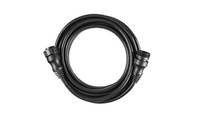
Garmin Panoptix Livescope Transducer Extension Cable

Garmin Panoptix LiveScope LVS12 Transducer Transom Mount - 010-12846-02
No compatible products found.
Sonar
| Sonar type | Live, real-time scanning sonar (Panoptix LiveScope) |
| Viewing modes | LiveScope Down and LiveScope Forward (no Perspective mode) |
| Frequency | 530 kHz to 1.1 MHz |
| Maximum depth/range | 61 m (200 ft) down and forward; dependent upon water salinity, bottom type and other water conditions |
| Field of view (beam coverage) | Front to back: two 30-degree sectors; side-to-side: 20 degrees |
| Transmit power | 500 W |
Connectivity
| Network connection | Connects directly to a compatible Garmin chartplotter (no GLS 10 sonar black box required) |
| Connector | 12-pin connector |
| Compass / stabilisation | Supports AHRS sensor for sonar image stabilisation (calibration required) |
Mounting
| Mounting options | Trolling-motor barrel mount and trolling-motor shaft mount (8-degree bracket) and transom mount included; optional extension bracket for deep-V hulls |
| Cable length | 20 ft |
Physical
| Dimensions (L x H x W) | 113 x 92 x 23 mm (4.45 x 3.6 x 0.91 in) |
| Weight (transducer only) | 500 g (1.1 lb) |
General
| Operating temperature | 0 to 40°C (32 to 104°F) |
| Storage temperature | -40 to 85°C (-40 to 185°F) |


